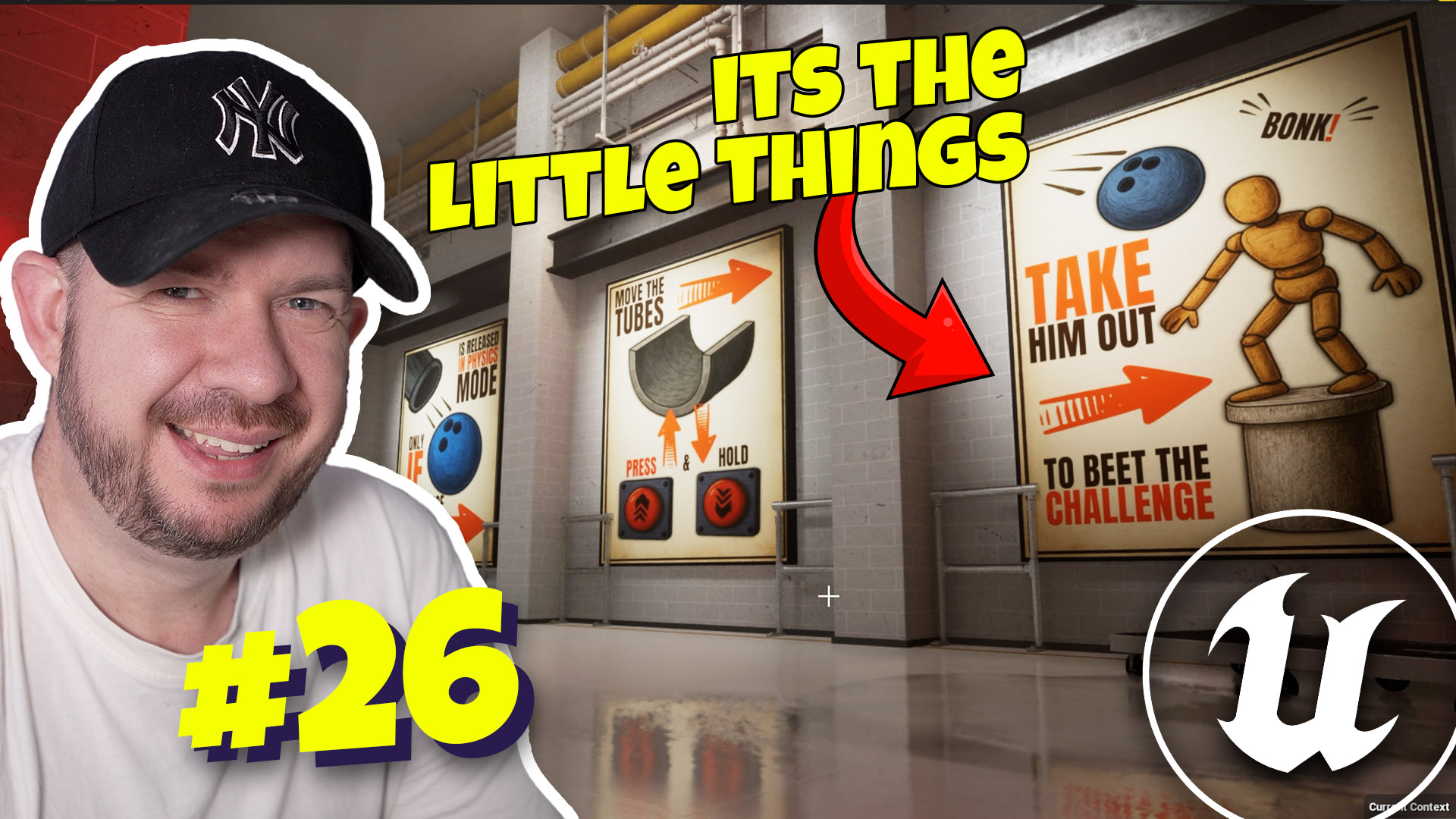
Devlog Episode 26 reaches a major milestone: opening the Unreal Engine build up for player testing. The episode walks through a large batch of changes driven by real playtester feedback, moving development from internal assumptions towards evidence from people actually playing the game.
The main development work in Episode 26
Opening the build to player testing changes the quality of information coming back to development. Instead of only asking whether a feature works as intended, testing starts revealing what real players notice, misunderstand, ignore or break.
The indexed description explicitly says the episode walks through a big batch of changes driven by real playtester feedback. It does not expose every item in that batch, so this retrospective does not invent a checklist of fixes, but the shift towards feedback-led iteration is itself the important milestone.
Looking back at Episode 26
Player testing is also where wording, pacing and assumptions can be challenged by people who did not build the system. A developer knows what a button is supposed to do; a tester only knows what the game communicates. That difference is why feedback-led changes can be so valuable.
The indexed description confirms that a large batch of changes came from real playtester feedback, but it does not enumerate that batch in the recoverable snippet. This retrospective keeps the emphasis on the milestone and leaves individual fixes out rather than guessing.
What changed in this devlog?
Real playtester feedback began driving a substantial round of iteration across the build.
- opening the game for player testing
- changes driven by real playtester feedback
- a large batch of iteration
Watch Devlog Episode 26
Watch the full episode to see the development work and the inevitable ragdoll consequences in context.
Watch RPE Devlog Episode 26 on YouTube
Follow RMF’s Ragdoll Physics Experiments
If you would like to follow the game’s development, visit the RMF’s Ragdoll Physics Experiments Kickstarter page and select Notify me on launch.